Realtors get paid at the closing of a home sale and get compensated as a percentage of the home's final sale price, usually receiving realtor commission through ACH direct deposit, wire transfer, or check. Nationwide, the typical buyer's agent earns 2.67% and the seller's agent earns 2.77%.
Here's how much realtors get paid on a median-priced home sale of $367,969:
- Listing agents would earn $10,193, while buyer's agents would earn $9,825.
- Sellers could pay approximately $20,018 in total commissions, assuming that they have agreed to also cover the buyer's agent fee, plus other closing costs (before accounting for any remaining mortgage balance.)
Now, for the good news: Realtor commissions are not fixed, so you can negotiate realtor fees to try to score a lower rate. Commission rates also vary depending on location and property type, among other factors.
It's best to consult a local realtor to better understand potential realtor fees. Clever Real Estate connects you with top-rated agents who offer free home valuation reports and detailed net sheets to help you accurately estimate your net profit. Plus, Clever’s partner agents charge just a 1.5% listing fee when you sell—helping you save thousands without sacrificing quality service. Fill out this form to get started!
How realtors get paid at closing
Realtors get their commission upon completing a home sale, a process known as "closing" or "settlement."
At this stage, the seller's title or escrow company oversees the transaction, prepares closing statements, and disburses funds. The commission payment gets transferred from the seller's title or escrow company to their brokerage.
Most real estate experts don't view realtor commissions as part of a seller's closing costs. These costs typically range from 1-3% of the home's sale price and cover expenses like title and escrow fees, transfer taxes, and recording fees. Nationwide, sellers face an average closing cost of 2.70%, or close to $12,000 on a $400,000 home sale.
Also note that real estate agents typically don't earn 100% of the commission from a sale, and brokerages have varying commission split policies. For instance, Anywhere Real Estate, which includes brands like CENTURY 21® and Coldwell Banker®, reported an 80% commission split in 2022.[1]
In other words, this means an agent who appears to earn $15,000 on a $500,000 home sale at a 3% commission rate would only take home around $12,000 after splitting the earnings with their brokerage.
Once the seller's brokerage receives the commission, they distribute the buyer's brokerage's share (if it's been negotiated in the contract), deduct any fees, and disburse the remainder to the agents. Payment often gets made via check or ACH deposit to the agent's bank account.
Is a commission model good for home sellers?
Supporters of the percentage-based commission structure argue that it incentivizes agents to speed up the sale process and secure the best possible price for the property.
The rationale is straightforward: Agents get paid only upon completing the sale. They don't get paid and forfeit the time and resources invested in marketing the property if they fail to secure a favorable offer.
Agents also earn a higher commission when the property sells for a greater price, giving them a vested interest in achieving higher offers.
Do sellers pay all realtor fees?
The seller typically covers the realtor fees for both parties, including the buyer's agent fee. These expenses are deducted from the home sale proceeds, sparing the buyer of additional out-of-pocket costs for their agent's services.
This industry norm is upheld by the National Association of Realtors (NAR), which previously mandated that brokers affiliated with Realtor-operated MLS platforms offer compensation to buyer's agents.[2]
The one exception is if the buyer chooses not to be represented by an agent. This scenario is uncommon, as statistics show that 89% of home buyers enlisted the help of a real estate agent or broker in 2023, up from 86% the previous year.[3]
Sellers are typically bound by contractual obligations to pay commission fees and can't refuse to pay a buyer's agent. Any refusal to follow contract terms could result in contractual conflicts and legal consequences.
🏡 Real estate commission changes are here!
After losing a lawsuit over their practices in 2024, the National Association of Realtors agreed to change how real estate professionals do business.
As of August 2024, buyer's agents are required to sign an "agency agreement" before providing services to a buyer. This agreement has to specify what services the agent will provide, and how much they will get paid.
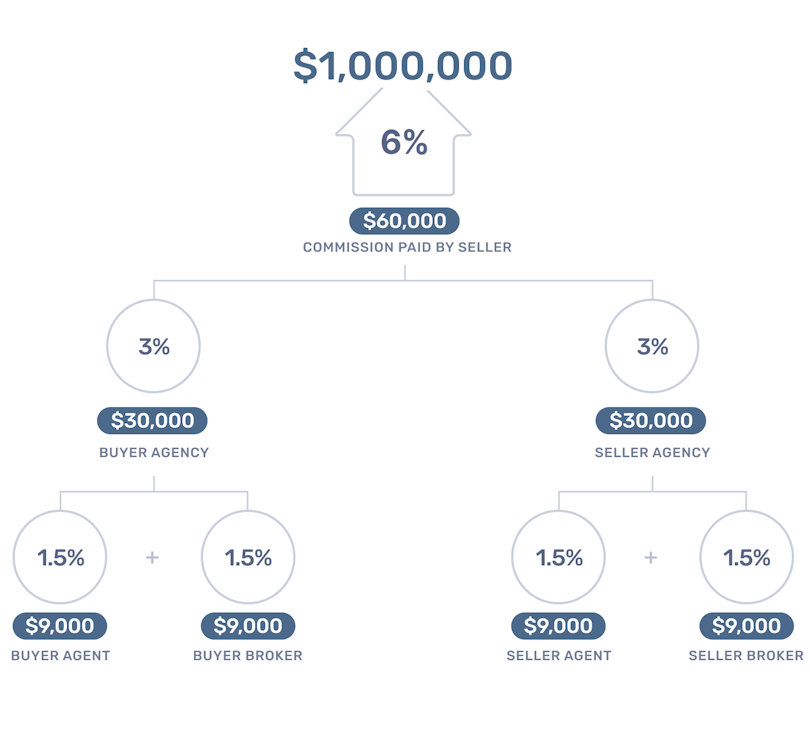
Real estate agents are no longer allowed to split commissions with one another. In the past, it was common for a listing agent to collect a 6% fee from the seller, and then split this fee with a buyer's agent who brought a buyer. Going forward, buyer's agents will have to negotiate their fee directly with the buyer they represent.
Learn more about how the real estate commission changes will impact buyers and sellers.
Who sets realtor commission rates?
Typically, both buyers and sellers negotiate the commission with their agents - sellers do so before listing their home for sale, while buyers negotiate when signing a buyer's agency agreement. This negotiation may result in an agreed-upon rate of 2.5-3% for each agent.
Factors such as local norms, property type, projected sales price, and home condition or desirability can inform this decision.
The commission rate is documented in the listing agreement or buyer's agency agreement. The listing agreement specifies fees and outlines terms authorizing the agent to market the home, including the initial listing price and what items will be conveyed with the property.
Does an exclusivity agreement affect commissions?
An exclusivity agreement grants the agent exclusive rights to market your home and collect payment upon sale. In rare cases, you might owe a commission even if the house doesn't sell, typically if the agent procures a willing buyer but the seller backs out.
Can negotiating commissions affect services?
Negotiating commissions can impact services, as agents may adjust the level of service offered, request assistance with marketing expenses, or extend the listing agreement duration. Negotiation success may be more likely if nearby homes are selling very quickly.
Is a real estate commission worth it for the seller?
Most sellers find real estate commissions worthwhile as they often lead to higher home prices. A recent study by Clever found that seven in 10 sellers think a good realtor is worth every penny of their commission.[4]
Full-service agents bring years of expertise, area knowledge, transaction experience, and negotiation skills, resulting in homes frequently selling at or above the asking price. Industry data indicates that homes sold with an agent typically fetch around $100,000 more than those sold FSBO.[5]
The work of a full-service agent includes:
- Prospecting for clients
- Crafting client proposals with pricing strategies
- Listing and marketing properties to attract buyers
- Negotiating offers and advising the seller on how to proceed
- Guiding sellers through the closing process.
A skilled realtor can also provide invaluable assistance in avoiding costly legal errors. According to recent research by Clever, over one-third (36%) of FSBO sellers encountered legal issues due to the absence of an agent.[6]
Alternatives to a percentage-based commission
Various alternatives to the traditional percentage-based commission model for realtors have emerged to accommodate the evolving needs of sellers seeking cost-effective options. These alternatives include:
- Flat fee MLS listing services. Sellers can pay a small fee upfront to list their property on the MLS without a realtor's help. The MLS is a widely used real estate platform, and posting it on the MLS will also blast your listing on the most popular real estate websites used by buyers. This option provides significant exposure for the property, as NAR found that approximately 86% of sellers utilize the MLS for listings.
- 1% commission realtors. Some sellers opt for real estate agents who charge a flat fee of 1% of the final sale price, which is lower than the typical 2.5–3% commission. However, it's crucial to thoroughly understand the costs and terms associated with working with these agents and to research their reputation through recent online reviews.
- Salaried agents. While uncommon, some agents are paid a salary by their brokerage, with commissions earned from selling homes. This model, used by companies like Redfin, may afford agents more time to focus on individual properties but could diminish their incentive to sell a house quickly and for top dollar.
How realtors get paid: The bottom line
Realtors are compensated at closing, typically deducted from the seller's proceeds. Fees average around 5.44%. Negotiating fees is an option, but studies find that very few sellers can successfully negotiate a lower rate.
Sellers can explore alternatives like Clever Real Estate, which has pre-negotiated the listing agent's commission to just 1.5%, providing significant savings.